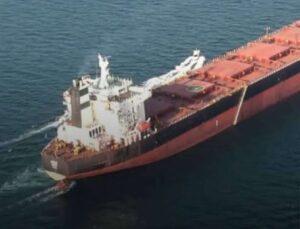




An Indian oil tanker has left West Asia with a large cargo of crude oil for India despite rising tensions in the region.
Bhaichara on top hai ji!
According to a report from Times Now, the Jag Laadki (an Indian flagged crude oil tanker), successfully departed from Fujairah, UAE, on March 14, even though the terminal was attacked earlier that day. While loading crude oil at the Fujairah Single Point Mooring, the terminal was attacked; this caused serious concern regarding maritime safety and energy supply to the region.
Despite this incident, the vessel departed the port at 10:30 a.m. IST on the 14th with approximately 80,800 tonnes of Murban crude oil destined for India. The Ministry of Petroleum & Natural Gas issued a confirmation of this fact in its official statement.
“On March 14, 2026, while the Indian-flag vessel Jag Laadki was loading crude oil at the Fujairah Single Point Mooring, the Fujairah oil terminal was attacked. The vessel sailed safely from Fujairah at 1030 hrs IST today carrying about 80,800 tonnes of Murban crude oil and is bound for India.”
At a time when tensions between Iran and Israel are escalating, the matter of Jag Laadki’s safe departure from the region is significant because she becomes the fourth Indian-flagged ship to leave the conflict-affected waters with no incident, thus continuing to facilitate the movement of urgently needed fuel supplies into India.
Welcome hai ji, apna hi garage hai. The fourth horseman of “thank god babaji” is finally here!
Timing is also important here, because India imports most of its energy (88 percent of its crude, 50 percent of its natural gas, and 60 percent of its liquified petroleum gas), and a significant amount of these imports come from West Asia (e.g. Saudi Arabia and the UAE). Therefore, when geopolitical conditions create disruptions in shipping around the Strait of Hormuz, they create global energy concerns.
In fact, the conflict has already caused a slowdown in shipping activity in that region, as 24 vessels have been stranded on the western side of the Strait, and another four vessels have been unable to transit the eastern side because of the escalating tensions. Nevertheless, some Indian vessels continue to navigate cautiously through the region.
On Saturday, both the Shivalik and Nanda Devi, which by the way, are LPG carriers with Indian flags, managed to make it through the Strait of Hormuz carrying 92,712 tonnes of LPG.
Shivalik is projected to reach Mundra, Gujarat on March 16 and Nanda Devi is expected to arrive at Kandla on March 17.
In addition to these new shipments, the tanker Jag Prakash crossed the Strait on Friday carrying gasoline from the port of Sohar, Oman, to Tanga, Tanzania with an estimated arrival date of March 21.
In the context of the evolving security environment in that area, the Directorate General of Shipping continues to coordinate the safe transport and return of Indian seafarers. A total of 276 Indian seamen have been returned from the Gulf with 23 in the last 24 hours.
When Shivalik & Nanda Devi Were Cleared For India…
The vessels are Shivalik and Nanda Devi, both owned by India’s government and operated by the Shipping Corporation of India (SCI).
Frankly, they sound like the two horsemen that avoided a crisis in the country.
The vessels are carrying an estimated 92,000 metric tonnes of liquefied petroleum gas to their destination ports in western India.
Rajesh Kumar Sinha, Special Secretary of India’s Ministry of Ports, Shipping, and Waterways, stated that the two vessels were able to transit successfully through the narrow straits of the Strait of Hormuz. “They crossed the Strait of Hormuz early morning safely and are en route to India,” Sinha stated at a media conference in New Delhi.
According to officials, the two vessels are expected to reach Mundra Port and the Kandla Port on March 16 and 17.
Iran’s Allowances for Maritime Traffic
Iran allowing the two LPG vessels to pass is a rare exception, as most commercial shipping through the Strait of Hormuz has been restricted due to the ongoing conflict.
Due to the military action on Iran by both the US and Israel, commercial movement through the Strait of Hormuz now is largely at a standstill. This event has created uncertainty within the global energy marketplace.
The strait, which is situated between Iran and Oman, is one of the most important maritime energy chokepoints in the world. About one-fifth of global oil and LNG typically travels through the narrow waterway.
In addition to having declared that Iran will obstruct cargo bound for the US or any Allied country, the country did grant an exception to Indian shipping by means of an agreement between India and Iran.
Bhaichara on top!
Accchaa, princess treatment for India?
Iranian Ambassador, Mohammad Fathali, has confirmed to India that as an exception, certain vessels from India will be allowed to cross the Strait of Hormuz.
The cargo of these two LPG carriers is estimated to contain approximately 92,000 metric tonnes of cooking gas (46,000 metric tonnes/tanker).
The representative indicated that the cargo from the LPG vessels will temporarily stabilize India’s LPG availability, thereby reducing the threat of supply disruptions resulting from blocked shipping activity in West Asia.
According to Reuters, after the unloading of the cargo, it should provide about 2 days of supply to India.
But what about the jeene ke hain chaar din?
Baaki dino ka kya?
Don’t worry India! Domestic production increased by 30%
LPG production domestically has peaked as a government response to alleviating the problems posed by the energy crisis.
According to officials, India has experienced a 30+% increase in domestic LPG production; this figure has accounted for approximately 10% of national daily LPG usage.
India’s existing supply of domestic natural gas is significantly reliant on foreign imports of LPG. This dependency is especially dominant within households as one potential use of LPG is cooking.
India used approximately 33.15 million metric tons of LPG in the last year; approximately 60% of that total amount supplied via foreign trade.
Approximately 90% of those foreign imports typically originate from countries located in the Middle East, making policymakers even more concerned about the associated supply disruptions in the Persian Gulf.
As tensions mounted in the region, the Government of India responded quickly to help shield consumers from experiencing supply shortages.
First, the government reduced supplies of LPG intended for industrial use; this allowed the remainder of LPG supplies to only be used to fulfil residential needs, therefore preventing a potential cooking gas shortage.
Governmental officials are also advising consumers not to engage in panic buying and to utilize pipeline natural gas (PNG) systems to supply their natural gas needs whenever possible.
There are over 333 million households connected to LPG; the results highlight the magnitude of the current supply shortfall associated with domestic and foreign sources of supply for LPG.